The HVAC Load Calculation Formula, Explained
By Danish Javaid, founder & editor · Published · Updated
Different heat paths need different equations. U × A × ΔT estimates surface conduction; airflow equations describe heat carried by air. Neither alone calculates a complete residential cooling load. Use the formulas below to check components, with the units and boundary conditions kept explicit.
Surface conduction: Q = U × A × ΔT
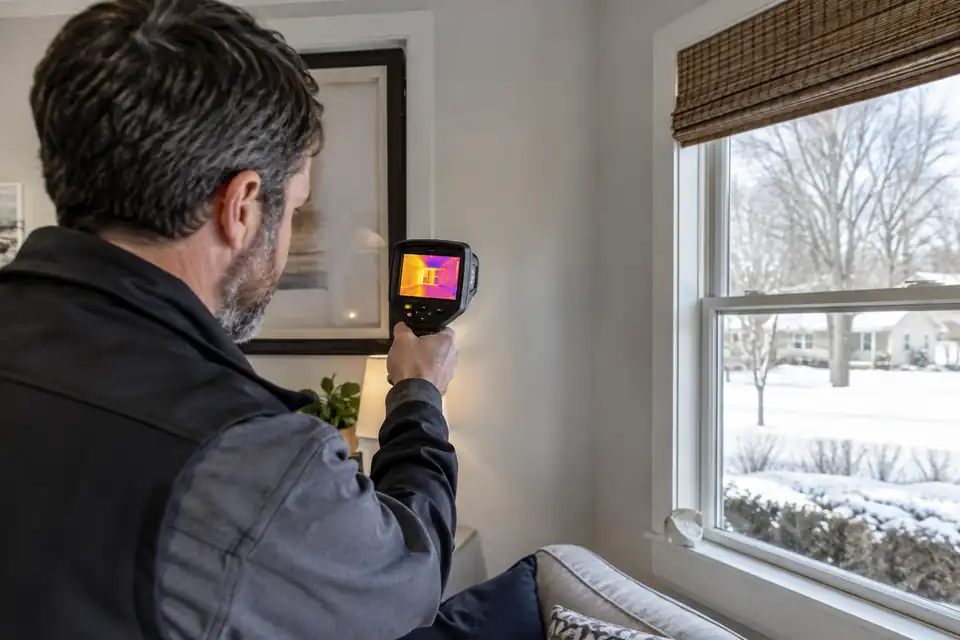
Q is heat transfer in BTU/h. U is the whole-assembly U-factor in BTU/(h·ft²·°F), A is the surface area in ft², and ΔT is the temperature difference across that assembly in °F. For a hypothetical 200 ft² exposed wall with U = 0.060 and ΔT = 50°F:
Conduction is usually the largest single term in a winter calculation, and it is the term a full Manual J evaluates surface by surface. Every wall, window, door, ceiling, and floor gets its own line, each with its own area, U-factor, and boundary temperature.
When U = 1/R is valid
U and R are reciprocals for the same assembly and units. An insulation product rated R-13 does not make the whole framed wall U = 1/13: framing, other layers, and thermal bridges change the assembly result. If the complete assembly resistance is R-20 in imperial units, its U-factor is 0.050. Use a documented assembly value or the load method's construction tables.
Simple steady-state conduction is useful for winter exposed surfaces. Summer roofs and walls need the method's solar and thermal-storage treatment. Ground-coupled floors also need an appropriate foundation method rather than the outdoor-air temperature difference.
Why the framing changes the answer
Parallel heat paths are averaged by U-factor, not by R-value. Suppose, with assumed values, that 75% of a wall's area is cavity with a path resistance of R-16 and 25% is framing with a path resistance of R-8. The area-weighted U-factor is 0.75 ÷ 16 + 0.25 ÷ 8 = 0.0469 + 0.0313 = 0.0781, so the effective assembly resistance is 1 ÷ 0.0781 ≈ R-12.8, about 20% below the cavity path. Averaging the two R-values directly would give R-14, which overstates the wall. The numbers here are illustrative; real assemblies come from the method's tables or tested data.
How much a square foot loses
| U-factor | Typical meaning (illustrative) | Loss per 100 ft² at ΔT = 50°F |
|---|---|---|
| 0.050 | Well-insulated wall assembly, R-20 | 250 BTU/h |
| 0.077 | Whole-wall R-13 | 385 BTU/h |
| 0.200 | Better glazing, R-5 | 1,000 BTU/h |
| 0.300 | Ordinary double-pane glazing, roughly | 1,500 BTU/h |
| 0.500 | Older or single-pane-type glazing, roughly | 2,500 BTU/h |
An example with a ceiling: a 1,000 ft² ceiling with an assumed whole-assembly R-19 has U ≈ 0.053. On a 30°F temperature difference it loses 0.053 × 1,000 × 30 ≈ 1,590 BTU/h. Run the same equation for every wall, window, and door, add them, and you have the conduction subtotal. The window row in the table is the reason glass area gets disproportionate attention: a given area of 0.30 glass loses about four times as much as the same area of 0.077 wall.
Sensible air heat: Q = 1.08 × CFM × ΔT
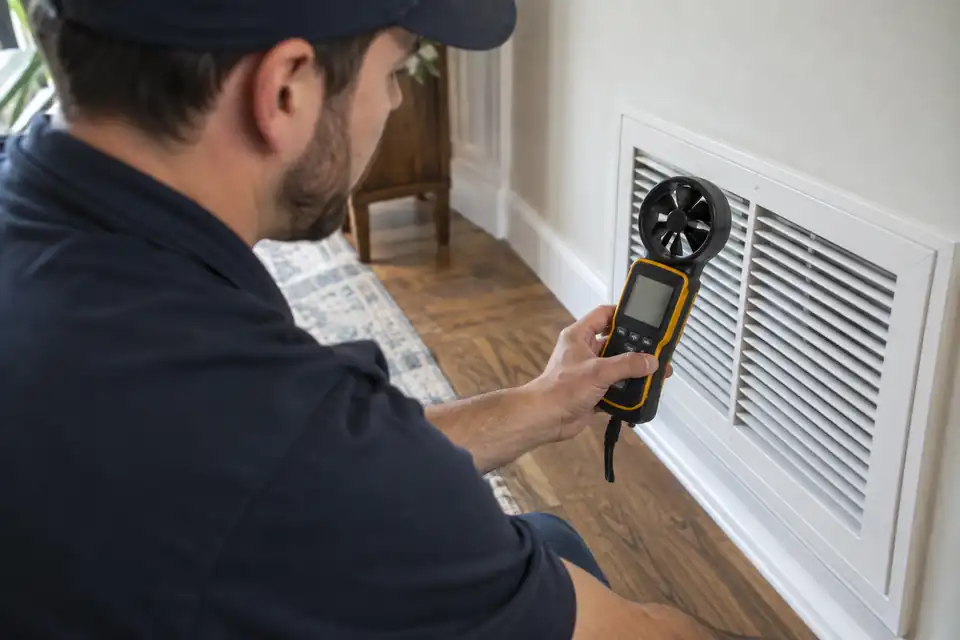
For standard air, 60 min/h × 0.075 lb/ft³ × 0.24 BTU/(lb·°F) = 1.08. CFM is actual airflow in ft³/min, and ΔT must be in °F. Density changes with altitude and conditions, so the constant is approximate.
A 10,800 BTU/h sensible room load with a 20°F room-to-supply difference requires approximately 500 CFM.
For supply airflow, compare room and supply temperatures. For infiltration or ventilation load, compare incoming outdoor air and indoor air. Do not use total cooling load, including latent heat, in this sensible equation. This is an airflow check, not enough information to choose a duct diameter.
The same equation in three uses
- Supply airflow for a cooling load. A 24,000 BTU/h sensible load needs 24,000 ÷ (1.08 × ΔT) CFM. The ΔT is the room-to-supply difference, so a smaller difference means more air.
- Temperature rise across a furnace. 60,000 BTU/h of output delivered by 1,200 CFM gives ΔT = 60,000 ÷ (1.08 × 1,200) ≈ 46°F. That figure should fall within the temperature-rise range on the furnace nameplate; it also shows that a blower with low airflow produces a hotter, narrower stream.
- Outdoor-air load. 100 CFM at a 20°F difference adds 1.08 × 100 × 20 = 2,160 BTU/h of sensible load, and the latent equation below adds the moisture term.
| Room-to-supply ΔT | CFM for 24,000 BTU/h sensible |
|---|---|
| 15°F | ≈ 1,481 |
| 18°F | ≈ 1,235 |
| 20°F | ≈ 1,111 |
| 22°F | ≈ 1,010 |
Infiltration airflow: CFM = ACH × volume ÷ 60
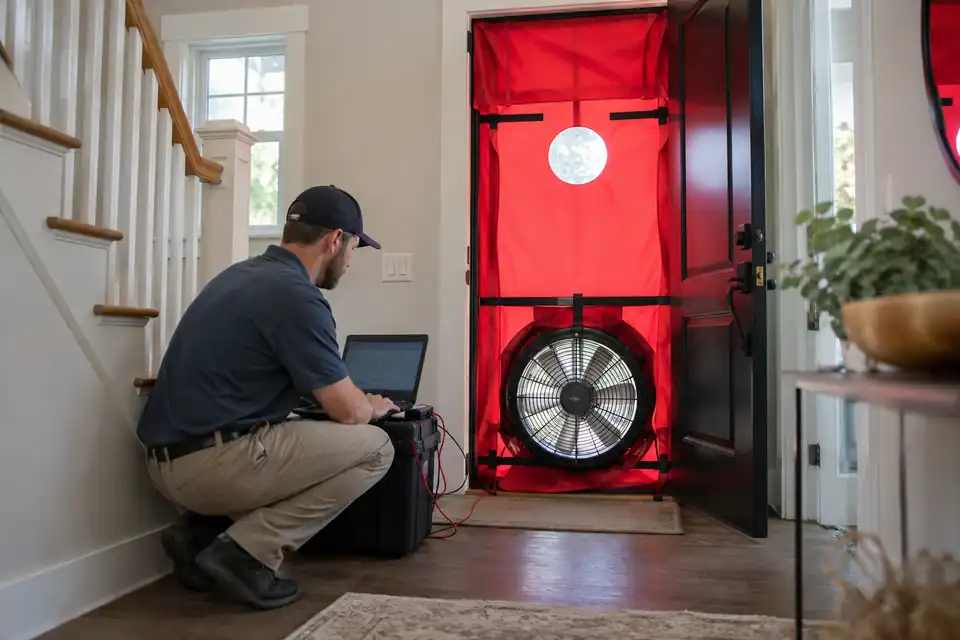
The ACH must represent natural infiltration for the condition being modeled. ACH50 is measured at a 50-pascal blower-door pressure and cannot be used directly. An appropriate procedure converts the test result using building and exposure information.
0.5 natural ACH is an assumed example value. With a 55°F winter difference, sensible heat = 1.08 × 120 × 55 = 7,128 BTU/h.
Intentional ventilation is a separate input. Its interaction with infiltration and any heat recovery must be modeled; simply adding every fan's nameplate airflow can double-count air exchange.
What leakage assumptions cost
| Natural ACH (assumed) | Airflow in 14,400 ft³ | Sensible heat at ΔT = 55°F |
|---|---|---|
| 0.20 | 48 CFM | 2,851 BTU/h |
| 0.35 | 84 CFM | 4,990 BTU/h |
| 0.50 | 120 CFM | 7,128 BTU/h |
| 1.00 | 240 CFM | 14,256 BTU/h |
The table makes the point that leakage is not a rounding detail. Going from 0.35 to 1.00 ACH in the same house adds more than 9,000 BTU/h at winter design conditions, and it also adds a latent load in summer. That is why measured leakage, converted properly, is worth collecting before sizing, and why air sealing can shrink a load more than any change in equipment size could.
Latent air heat: Q ≈ 0.68 × CFM × Δgrains
Δgrains is the difference in humidity ratio, in grains of water per pound of dry air; 7,000 grains equal one pound. Relative humidity percentage is not interchangeable with humidity ratio. The coefficient is an approximation at standard air conditions.
This is one outdoor-air moisture contribution. Occupants and indoor moisture sources need their own treatment.
The coefficient follows the same logic as 1.08: 60 min/h × 0.075 lb/ft³ of air × the latent heat of water (roughly 1,050 to 1,076 BTU/lb depending on the reference) ÷ 7,000 grains/lb gives approximately 0.68 to 0.69. The sensible heat ratio then reads as sensible ÷ (sensible + latent). In the 120 CFM example, if the sensible term for the same airstream were 1.08 × 120 × 20 = 2,592 BTU/h, the airstream's SHR would be 2,592 ÷ (2,592 + 2,856) ≈ 0.48. That is far lower than the overall house SHR, which is why ventilation air is so demanding on dehumidification.
To get grains, use a psychrometric chart or the psychrometric calculator with dry-bulb temperature and relative humidity. A comfortable indoor condition of about 75°F and 50% relative humidity is roughly 65 grains/lb. A hot, humid outdoor condition can be 40 to 50 grains/lb or more above that, which is the range the 35 grains/lb in the example represents on a moderately humid day.
Thermal watts and refrigeration tons
| Conversion | Checked example |
|---|---|
| Thermal W × 3.412 ≈ BTU/h | 1,000 W ≈ 3,412 BTU/h |
| BTU/h ÷ 12,000 = tons | 30,000 BTU/h = 2.50 tons |
| Sensible ÷ total = SHR | 24,000 ÷ 30,000 = 0.80 |
Electrical input to a heat pump is not thermal output. Likewise, a conversion with the AC tonnage calculator expresses the load; it does not guarantee a nominally matching unit meets that load at design conditions.
One ton is 12,000 ÷ 3,412 ≈ 3.52 kW of thermal power, and one horsepower is about 2,545 BTU/h. A 1,500 W space heater delivers 1,500 × 3.412 ≈ 5,118 BTU/h of heat to the room, regardless of the heater's price or marketing. The unit converter covers the remaining conversions.
Assemble totals without a hidden safety factor
Keep separate sensible and latent cooling columns for envelope/solar gains, outdoor air, internal gains, and distribution effects. Add each component once. Heating follows the chosen method's loss calculation and generally does not credit intermittent solar or internal gains. An automatic 10% increase is not a substitute for accounting for omitted components.
| Component | Governing relation | Columns |
|---|---|---|
| Surface conduction | Q = U × A × ΔT (winter); method-specific temperature differences in summer | Sensible |
| Solar through glass | Area × SHGC × solar intensity × shading, by orientation and hour | Sensible |
| Infiltration and ventilation | 1.08 × CFM × ΔT and 0.68 × CFM × Δgrains | Sensible and latent |
| People | About 230 BTU/h sensible and 200 BTU/h latent each, under common Manual J assumptions | Both |
| Appliances and lighting | Watts × 3.412 × usage fraction | Mostly sensible; cooking adds latent |
| Ducts | Conduction and leakage terms from duct location | Both |
Use ACCA Manual J, 8th edition for the residential procedure and the ASHRAE Handbook—Fundamentals for heat-transfer and psychrometric background. A designer then applies Manual S equipment-selection rules. The worked example shows why total, sensible, and latent capacity checks are all needed; the CFM calculator helps check the airflow arithmetic.
From total load to equipment checks
Divide the total cooling load by 12,000 to express it in tons. Then compare the delivered capacity of a specific unit at your design conditions with the load using commonly cited Manual S ranges: about 95–115% of total cooling load, up to about 125% for a heat pump in a heating-dominated climate, and about 100–140% of heating load for a furnace. Equipment output is not its label. Furnace output equals input × AFUE, so a 40,000 BTU/h heating load with the 100–140% range needs 40,000 to 56,000 BTU/h of output, which is 40,000 ÷ 0.96 ≈ 41,667 to 56,000 ÷ 0.96 ≈ 58,333 BTU/h of input at 96% AFUE.
For cooling, a 30,000 BTU/h load has a 95–115% window of 28,500 to 34,500 BTU/h of total capacity, and the sensible and latent parts of that capacity must cover 24,000 and 6,000 BTU/h respectively. A margin added to the load itself is not part of that procedure: the limits are applied to equipment capacity against the load, not stacked on top of a padded load. Keeping this distinction avoids the familiar chain of “add 10% to the load, round up to the next ton, then add a bigger blower.”
Altitude and non-standard air
The constants 1.08 and 0.68 assume air at roughly sea-level density. At higher elevation, air is less dense, and the same volumetric flow carries less heat. At about 5,000 ft under standard-atmosphere conditions, the sensible constant is closer to 0.93 than 1.08, and the latent constant falls by a similar proportion. Equipment capacity and fan performance also change with altitude, so high-elevation projects need the manufacturer's altitude data and a method that handles density, not a simple edit to the constants. Do not apply an altitude correction to one formula and not another in the same calculation.
Formula mistakes that cause big errors
- Using R in place of U. Invert the whole-assembly R-value first, or the conduction term is off by an order of magnitude.
- Using total load in the sensible equation. Only sensible load belongs in 1.08 × CFM × ΔT.
- Mixing CFM and ACH. CFM is per minute and ACH is per hour; divide by 60 when converting.
- Using relative humidity as grains. Convert to humidity ratio first.
- Using the wrong ΔT. Supply airflow uses room-to-supply difference; leakage uses outdoor-to-indoor difference.
- Treating electrical watts as heat pump output. Thermal output depends on efficiency, which is greater than 1 for heat pumps in many conditions.
- Counting ventilation twice. Use either a modeled combined infiltration and ventilation approach or separate components, but not both for the same air.
Calculation guidance is reviewed against our published methodology. To report an error or request a correction, use the contact page.