What Size AC Do I Need? A Sizing Chart by Sq Ft and Climate
By the Calculate HVAC Load editorial team · Published · Reviewed
Air conditioners are sized in tons of cooling capacity, and picking the right number is the single biggest factor in whether your home feels comfortable, stays dry, and keeps energy bills reasonable. This guide gives you a quick sizing chart by square footage and climate, then explains why those numbers are only a starting point — and why going one size too big is just as bad as going one size too small.
Tons and BTU: what AC capacity actually means
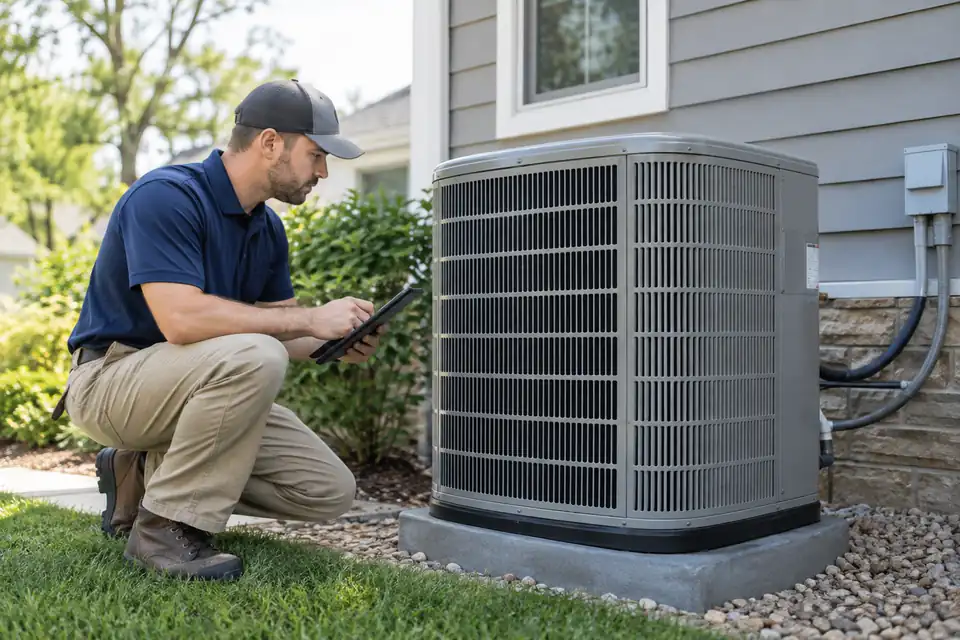
Cooling capacity is measured in BTU per hour, the amount of heat the unit can remove from your home in an hour. Equipment is sold in tons, a holdover from the days when cooling was rated against the heat absorbed by melting ice. One ton equals 12,000 BTU/hr, so a 3-ton system removes 36,000 BTU/hr at design conditions.
Residential central AC typically ranges from 1.5 to 5 tons in half-ton steps. You almost never see a quarter-ton size, which is why rounding lands on the nearest half ton.
Your goal is to match the unit's capacity to your home's cooling load— the heat it gains on a hot design day. Sizing is about meeting that load, not exceeding it.
Quick AC sizing chart by square footage and climate

The table below is a fast first estimate. "Warm" covers hot, humid southern climates (roughly IECC zones 1–3), "mixed" covers the temperate middle of the country (zones 4–5), and "cold" covers cooler northern climates (zones 6–8) where summer cooling loads are lighter. Figures assume an average, reasonably insulated home with 8-foot ceilings.
| Home size | Warm climate | Mixed climate | Cold climate |
|---|---|---|---|
| 1,000 sq ft | 1.5 tons | 1.5 tons | 1.0 ton |
| 1,500 sq ft | 2.5 tons | 2.0 tons | 1.5 tons |
| 2,000 sq ft | 3.0 tons | 2.5 tons | 2.0 tons |
| 2,500 sq ft | 4.0 tons | 3.0 tons | 2.5 tons |
| 3,000 sq ft | 4.5 tons | 3.5 tons | 3.0 tons |
Why square footage alone is unreliable
Square footage is the loudest variable, so charts lean on it — but the cooling load depends on how fast heat enters the house, and that is driven by the building envelope, not just floor area. Several factors can each swing the load by 10–30%:
- Insulation. A tightly insulated home gains heat slowly and may need a full ton less than a poorly insulated home of the same size. Attic and wall R-values matter more than most owners expect.
- Windows. Glass area, the number of panes, and low-E coatings dramatically change solar gain. A wall of single-pane windows can add the equivalent of several hundred square feet of load.
- Sun exposure and orientation. West- and south-facing rooms bake in the afternoon. A shaded lot or mature trees can shave meaningful capacity off the requirement.
- Ceiling height. Cooling load tracks volume, not just floor area. Vaulted 10- or 12-foot ceilings add conditioned air the chart never accounts for.
- Air infiltration. A leaky house constantly pulls in hot, humid outdoor air. Air sealing and tight ductwork lower the load without touching the floor plan.
- Internal gains. Occupants, kitchens, and electronics each add heat. A busy household with a sunny kitchen carries a higher load than the square footage suggests.
This is why HVAC professionals run a Manual J load calculation rather than reading a chart. Our AC size calculatorapplies the same adjustments — climate zone, insulation, sun, ceiling height, and occupants — so your estimate reflects your actual house.
Why you should not oversize
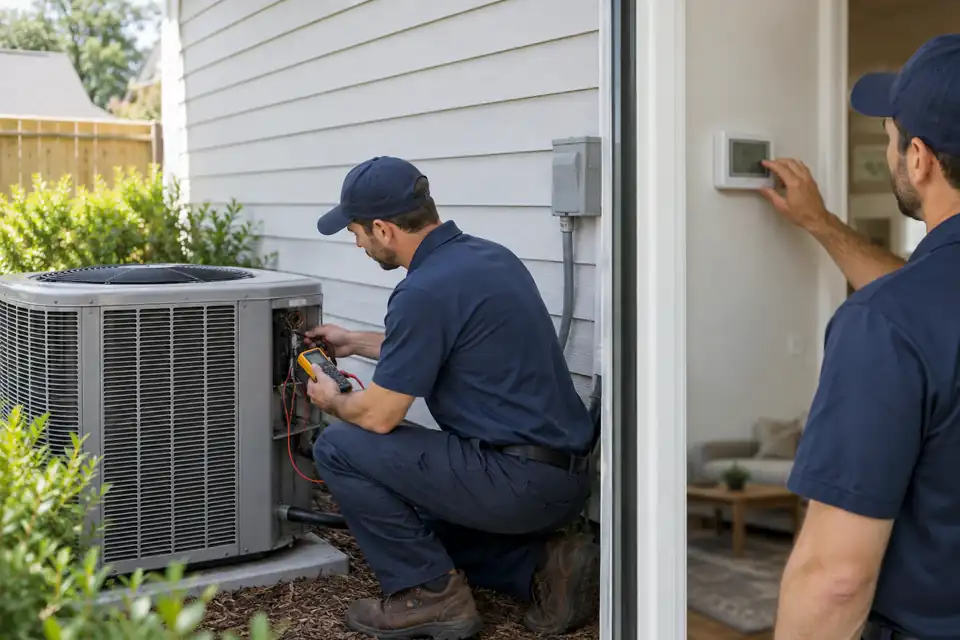
The instinct to round up "to be safe" is the most common sizing mistake, and it backfires. An oversized air conditioner cools the air temperature quickly, satisfies the thermostat, and shuts off before it has run long enough to pull humidity out of the air. The result is a home that feels cold and clammy rather than cool and dry.
The hidden costs of too much capacity
- Poor dehumidification. Short cycles remove temperature but not moisture, leaving a damp, sticky feel even at a low setpoint.
- Short cycling. Frequent on-off bursts wear out the compressor and contactor faster than long, steady runtimes.
- Uneven temperatures. Rooms farther from the air handler never get enough runtime to balance out before the unit shuts down.
- Wasted money. You pay more upfront for capacity you cannot use efficiently, and the inrush from constant restarts can raise energy use.
Undersizing has the opposite failure mode — the unit runs continuously on the hottest days and still cannot hold the setpoint. The sweet spot is a system sized right at the calculated load and rounded to the nearest half ton, which gives long, steady cycles that both cool and dehumidify.
From square feet to a confident size
Start with the chart to get in the right neighborhood, then refine. Once you have a cooling load in BTU/hr, converting to tons is simple division — the tonnage calculator handles the BTU-to-ton conversion and rounding for you if you already know your load figure.
For the full picture, plug your square footage, climate zone, insulation, sun exposure, ceiling height, and occupants into the AC size calculator. It turns the rule-of-thumb chart above into a tailored recommendation in seconds, so you can walk into a quote knowing the right number instead of trusting a contractor to round up for you.
Calculation guidance is reviewed against our published methodology. To report an error or request a correction, use the contact page.