How to Measure Your Home for HVAC Sizing
By Danish Javaid, founder & editor · Published · Updated
Prepare a room sketch, a dimension sheet, and photos of construction labels before requesting an HVAC load calculation. The designer needs the boundaries of the conditioned space and the heat-transfer properties of its surfaces, not just the square footage on a property listing.
Mark the conditioned boundary first
Identify which spaces are intentionally heated or cooled and which system serves each one. A vented attic or unconditioned garage lies outside that boundary. A basement can be inside the thermal envelope even without a supply register, so confirm its intended temperature and insulation boundary rather than deciding from the presence of a vent alone.
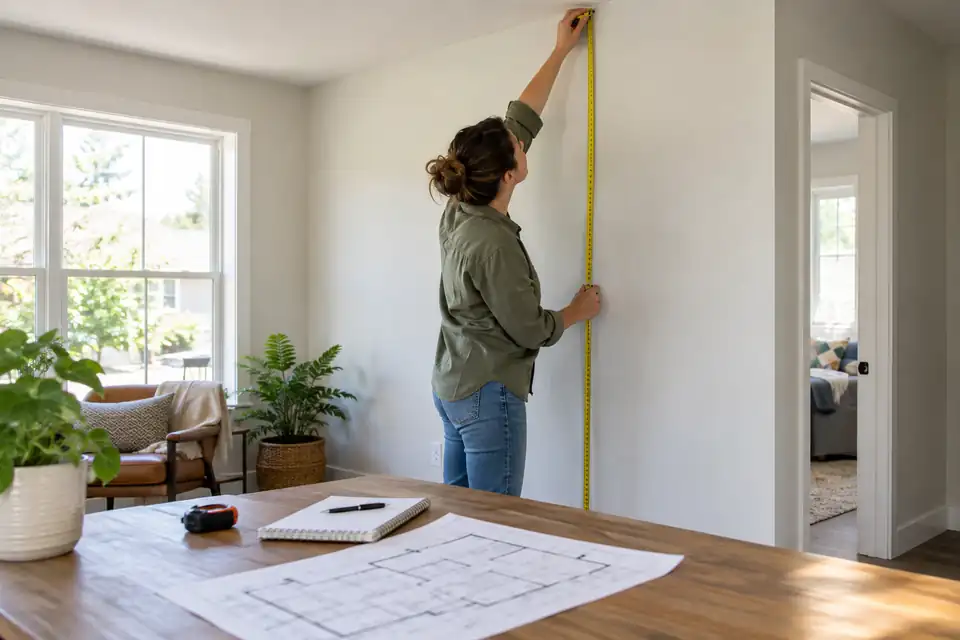
Measure each floor separately and mark stair openings and double-height rooms. Do not count an open-to-below space as floor area twice. Label partitions between conditioned rooms separately from exterior walls. For a formal report, follow the software's dimension convention consistently; interior room measurements and exterior envelope dimensions are not interchangeable.
Spaces that are commonly miscounted
- Attached garage: usually outside the boundary. A wall between the house and a garage is a boundary to an unconditioned space, not an exterior wall and not an interior partition.
- Vented attic: not conditioned floor area. Its temperature in summer can sit far above the outdoor air, which matters for the ceiling and for any ducts routed through it.
- Basement: include it if it is finished or intentionally conditioned. Leave it out of floor area if it is not, but still record it as the space below the first floor.
- Bonus room over a garage: conditioned, but with an unconditioned space below and often a sloped ceiling above. It is the room most likely to be uncomfortable when the whole-house number looks right.
- Screened porch or shed: not part of the system's load unless it is closed in and served.
The reason this matters is arithmetic. Using a rough screening figure of 20 BTU/h per ft², counting a 500 ft² garage as conditioned adds 500 × 20 = 10,000 BTU/h, or 10,000 ÷ 12,000 ≈ 0.83 ton, to a hand estimate for space nobody is trying to cool. A screening figure is not a design value, but it shows how a single measuring mistake can move the result by most of a ton.
Calculate area and volume without decimal-foot errors
| Measurement | Calculation | Result |
|---|---|---|
| Rectangular room | 12 ft × 15 ft | 180 ft² |
| Room volume | 180 ft² × 8 ft | 1,440 ft³ |
| Length of 12 ft 6 in | 12 + 6 ÷ 12 | 12.5 ft |
| Window | 3 ft × 5 ft | 15 ft² |
| Opaque wall | 20 ft × 8 ft − 15 ft² window − 21 ft² door | 124 ft² |
Split an L-shaped room into rectangles and add their areas. For a ceiling sloping uniformly from 8 to 12 ft, the average height is 10 ft; a 180 ft² room then holds 1,800 ft³. Record the actual ceiling shape too, because a load model also needs the roof/ceiling surface geometry.
A 14 ft room has 75% more air volume than the same footprint at 8 ft, since 14 ÷ 8 = 1.75. This does not mean its total HVAC load rises 75%: surface areas, insulation, leakage, and solar gains determine the change.
Gross and net wall area
For a whole-house survey, measure the perimeter of the conditioned envelope and multiply by wall height to get gross exterior wall area, then subtract every window and door opening to get net opaque wall area. A 40 × 30 ft single-story footprint has a perimeter of 2 × (40 + 30) = 140 ft. At 8 ft high, gross wall area is 1,120 ft². With eight 15 ft² windows (120 ft²) and two 21 ft² doors (42 ft²), net opaque wall is 1,120 − 120 − 42 = 958 ft². For a two-story house, do each floor separately, because the rim area between floors and different ceiling heights change the totals.
Tools and order of work
A laser distance meter or a 25 ft tape is enough. Sketch each floor first, then measure room by room and write the dimension on the sketch, not on a separate list that can drift out of order. Measure ceiling height in each main room instead of assuming 8 ft, since renovations and basements often differ. Round to the nearest inch or half foot; more precision than that is false confidence, and a plan view that does not close (rooms that add up to more than the footprint) is a signal to remeasure rather than average.
Survey every window and door
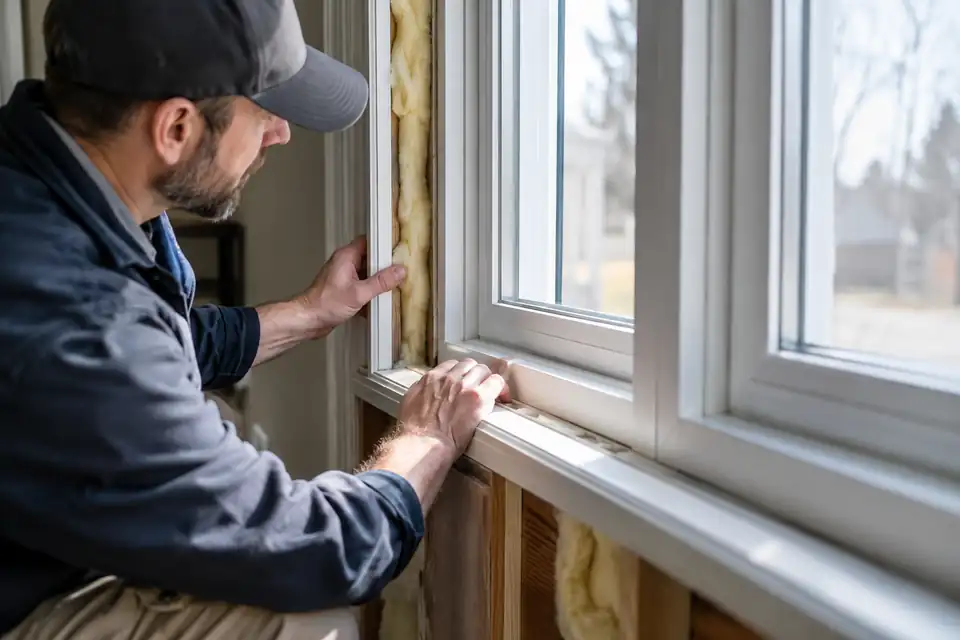
- Assign an ID matching the floor plan, and record width, height, compass direction, and room served.
- Photograph manufacturer labels or obtain specifications for U-factor and solar heat gain coefficient (SHGC). Low-e coating and pane count alone do not determine either value.
- Measure permanent exterior shading such as overhang depth and its position above the window. Note screens, interior shades, and nearby obstructions separately.
- Follow the model's opening-area convention and subtract those openings from opaque wall area. Avoid entering the same glass as both wall and window.
Glass matters because it conducts heat faster than an insulated wall does. With illustrative whole-assembly U-factors of 0.30 for a window and 0.07 for a wall, a 15 ft² section loses 15 × 0.30 × 52 = 234 BTU/h as a window and 15 × 0.07 × 52 ≈ 55 BTU/h as wall at a 52°F winter temperature difference, about four times as much. In summer the window also admits sunlight, which the wall does not.
Orientation changes when the peak occurs
East glass peaks in the morning, west glass in the late afternoon when outdoor temperatures are already high, and south glass near midday, where a properly sized overhang can shade much of it in summer. North glass receives little direct sun in the northern hemisphere. A room with a large west window may hit its peak later and higher than the rest of the house, which is why it can be uncomfortable even when total capacity is adequate. Write down which wall each window is on and the direction the front of the house faces; the designer can then assign orientation consistently.
Record assemblies and the adjacent spaces
| Surface or system | What to record | Useful evidence |
|---|---|---|
| Walls | Framing, layers, insulation, adjacent space | Plans, renovation records, accessible construction |
| Ceilings/roof | Insulation type, coverage, roof or attic boundary | Material label and depth/coverage photos |
| Floors | Slab, basement, crawlspace, or garage below | Foundation details and insulation location |
| Ducts | Location, insulation, leakage condition | Layout and leakage test report |
| Ventilation | Supply/exhaust flow and recovery equipment | Commissioning sheet and model data |
Do not turn insulation depth into a precise R-value without the material's labeled coverage data. Do not assume a wall's cavity R-value equals its whole-assembly resistance. Mark inaccessible details as unknown so the designer can explain the assumption rather than hide it.
The ceiling and the floor
The ceiling-to-attic plane is often a large heat path, especially in cooling season, when an unconditioned attic can be much hotter than the outdoor air. If you can reach the attic safely, photograph the insulation with a ruler or tape visible for depth. Loose-fill fiberglass and cellulose give different R-value per inch, so depth alone is not an R-value; record the material and the depth and let the designer apply the right figure. Thin or uneven coverage near eaves is worth noting separately. Do the same for floors over crawlspaces or garages: an uninsulated floor over a vented crawlspace behaves like an exposed surface, and a floor over a garage is a common source of cold rooms.
Count exterior doors separately
An exterior door is not the same as the wall around it. A solid insulated door and a hollow or glazed one have different U-factors, and sliding glass doors are measured as glazing. Record each door's size, material, and whether it has glass, and subtract its area from the wall. Garage-to-house doors lead to an unconditioned space and belong on the sketch as such.
Keep leakage tests in their original units
A blower-door result at 50 pascals, often written ACH50 or CFM50, describes leakage under test pressure. It is not natural air changes per hour. Give the designer the original report, building volume, test pressure, and test date so the selected procedure can estimate infiltration. Drafts are clues to investigate, not a measured airflow.
Without a test, you can still collect useful clues. Note the year the house was built and whether the envelope was renovated. Feel for air movement on a windy day around outlets on exterior walls, baseboards, window and door frames, recessed lights, attic hatches, and plumbing penetrations. Infiltration can be a large share of the load in a leaky house, in some homes rivaling the conduction through the walls, but you cannot read the number from drafts. If a utility or an energy auditor offers a blower-door test before an equipment purchase, it is usually inexpensive compared with the equipment and sharpens one of the most uncertain inputs.
Hand over a reproducible input package
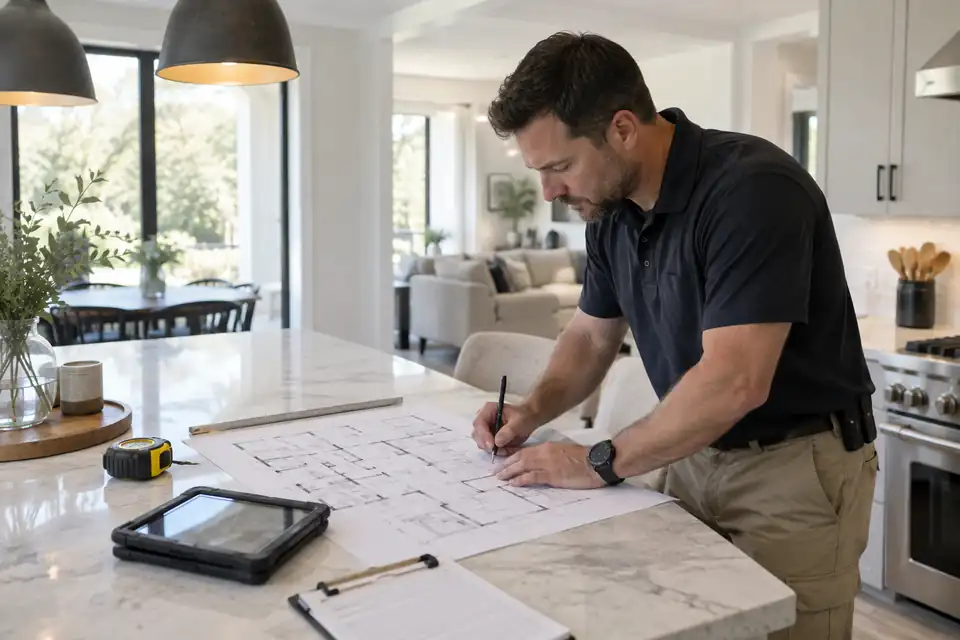
- Include a dated floor plan, room dimensions, envelope areas, window IDs, and all test reports.
- List planned air sealing, insulation, additions, and window changes. Specify whether the design is for the current or improved home.
- Flag uncertainties such as concealed insulation or an attic boundary you cannot identify. Avoid unsafe access to unfinished attic areas.
Measurement checklist at a glance
| What to measure | Why it matters |
|---|---|
| Conditioned floor area | Sets the size of the thermal volume and the surfaces around it |
| Ceiling height | Converts area into air volume; tall rooms add volume and often more exterior surface |
| Window count, size, and orientation | Glass area and direction set conduction and solar gain |
| Glazing U-factor and SHGC | Pane count and low-e coating alone do not provide either value |
| Exterior wall area and assembly | Opaque conduction; use the whole assembly, not just the cavity R-value |
| Doors | Different U-factor from the wall; doors to a garage are a boundary to an unconditioned space |
| Attic and floor insulation | Large surfaces with often uneven coverage |
| Air-tightness evidence | Infiltration is one of the most uncertain inputs; use a test report if available |
| Duct location | Ducts in an attic or crawlspace add gains and losses |
| House orientation | Determines which facades take the sun and the prevailing wind |
Turn your measurements into a load
- Total the conditioned area by floor and confirm nothing unconditioned slipped in.
- Enter ceiling heights, window data, wall and ceiling assemblies, leakage information, and the number of occupants.
- Run heating and cooling separately, keeping sensible and latent cooling in separate columns.
- Compare the result with a rough screening range and look for units or counting errors if it falls far outside.
A quick accuracy check
As a sanity test only, many reasonably insulated homes in moderate climates land roughly near 20 to 30 BTU/h of cooling load per ft² of floor area. Hot, humid, glassy, or poorly insulated homes can exceed that, and very tight, well-shaded ones fall below it. Treat this as a screen, not a design value. If your result is far outside it, recheck the measurement that moved it, usually area, ceiling height, window area, or the assembly R-value.
These records support the building survey used by ACCA Manual J, 8th edition. Use the residential HVAC load calculator for an initial estimate from your measured house, or the BTU calculator for a single room; ask a qualified designer to investigate unusual geometry or unknown construction before final sizing. The report review checklist helps confirm that the measured inputs reached the calculation, and the load calculation walkthrough shows what the designer does with them.
Calculation guidance is reviewed against our published methodology. To report an error or request a correction, use the contact page.